
A light is switched on, but is it actually working?
Switching on a navigation light does not, by itself, confirm that it is illuminated. A bulb may have failed or an electrical connection may be faulty. A traditional mimic panel uses separate indicators to show light status, taking up panel space and requiring additional indicator wiring. Even then, a switch shown as on does not confirm that the light is drawing current.
How does YatComm monitor the lights?
YatComm’s five current-monitored outputs can be assigned individually to the starboard, port, masthead, stern and anchor lights. The system monitors the current drawn by each output while it is switched on. If the current drops below the threshold set for that light, it raises a fault alarm. This can help reveal a failed bulb or an open circuit; the alarm does not, on its own, identify the exact cause.
What appears on the onboard display?
The onboard touchscreen provides separate controls for the five lights and shows their status and measured current on one page. Light information can therefore be brought together on the display instead of using a separate mimic panel and its indicator wiring. The lights still need their power cables and appropriate electrical connections. If low current is detected on a switched-on light, the associated fault appears as an alarm on the display.
A real installation and connection capacity
In a completed boat installation, all five lights — starboard, port, stern, masthead and anchor — were connected to YatComm control outputs. Consider a light that is switched on while underway but stops drawing the expected current: the operator can see more than the switch position and receives a fault warning for that circuit.
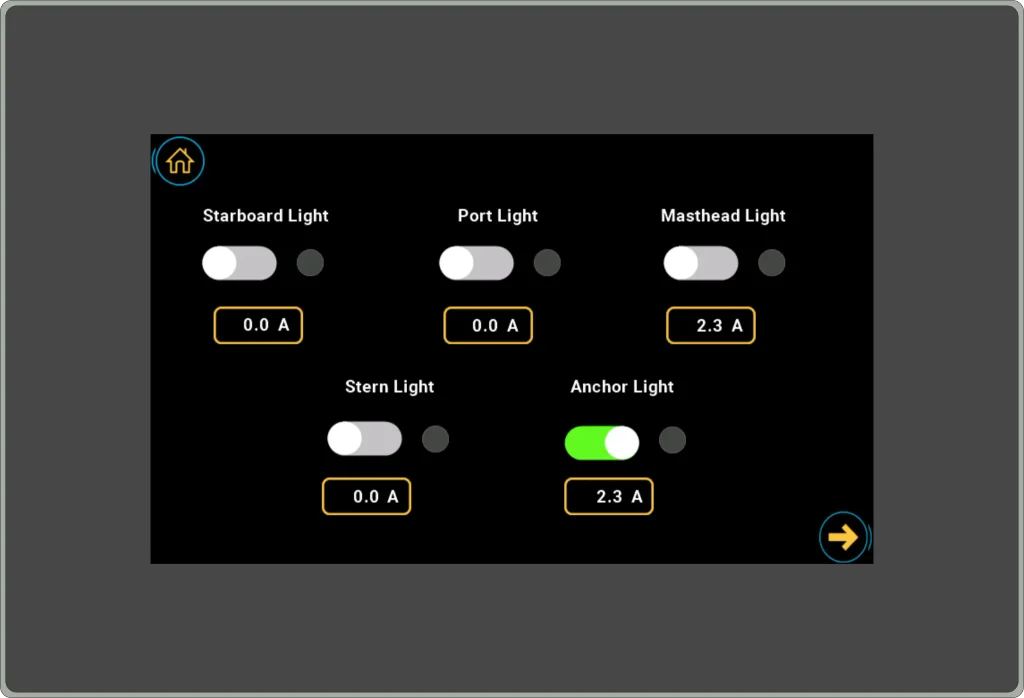
YatComm provides five current-monitored outputs and five standard outputs, each rated at 4 A. In this arrangement, the five monitored outputs are assigned to the lights. The current drawn by each light and the boat’s wiring are assessed during installation. This arrangement does not call for a separate current measurement module for the lights; the onboard touchscreen provides local control and display.
Explore the input and output list from the real installation. See where the other outputs fit in the YatComm system connection diagram. To discuss your boat’s lighting installation, contact YatComm.